How Stan, Clay and Pylon get their whole team posting on LinkedIn

John Abhishek
building parasiite.so
On this page
To get your whole team posting on LinkedIn, make it easy and make it theirs. Leaders post first, every person gets a topic from their real job, the blank page goes away, and each person sees which of their posts brought in buyers.
Sorry to burst your bubble if you were hoping for a Slack message that says "everyone please reshare this." That has never worked. Not once.
What works is what Stan, Clay and Pylon actually did. I dug into how each of them built it, with their own numbers, and turned it into a 30-day plan you can copy.
Stan: from two founders posting to 150 team posts a month
For years, Stan's LinkedIn presence was its two co-founders, John Hu and Vitalii Dodonov. Their posts were most of the company's content.
That changed when Stan built Stanley, an AI agent that helps people write LinkedIn posts. Stan's own team became its first users. According to Stan's blog, people on every team now post weekly, some several times a week: developers, support, partnerships and marketing.
What it produced in 30 days, as Stan reports it:
| Metric | Number |
|---|---|
| Team size | 68 people |
| Employee posts | 150 |
| Engagements | 12,700 |
| Hires credited to the posts | 7 |
| Reach of one internship post | 215,000 people, with 500 asking for the application link |
My favorite line from Stan's write-up: "Now, we don't have to ask our team to post on LinkedIn each week."
Nobody nags anyone. They removed the hard part, which is writing.
Stan also keeps a Slack channel where people share their posts and wins, so posting is something the team does together, not homework.
Launchpad: a story the whole team can document
Then Stan went bigger. Much bigger.
In September 2026 it announced Launchpad, a 14-day competition for about 100 early-stage founders in 30 teams at a camp in the Poconos, with a $100,000 prize. There are masterclasses, elimination rounds, guest speakers including Gary Vaynerchuk, and a Demo Day in front of investors.
The whole thing is filmed as a documentary series, and the founders taking part document their journeys as they go.
Dodonov's line in the announcement sums up why: "Building is easy. Distribution is hard."
Think about what a game show does for a team's content calendar. Weeks of things to post about: who's leading, who got cut, what a founder learned on day 6. Every employee has a front-row seat and a reason to post.
Lesson from Stan: Don't ask people to post. Make it easy, then give them something worth posting about.
Clay: one executive voice for each type of buyer
Clay sells to several different buyers: founders, sales leaders, growth leaders and the people who build GTM systems. Instead of one founder trying to speak to all of them, different leaders cover different audiences:
- Kareem Amin and Varun Anand (co-founders) speak to founders and executives
- Everett Berry (Head of GTM Engineering) speaks to GTM engineers
- Other leaders cover sales and growth
Each buyer sees posts from someone who does their job. Simple, and surprisingly rare.
Clay made a job title its users post about
Clay's bigger move was naming a profession. Co-founder Kareem Amin called the GTM engineer "the first true AI-native profession". Head of Marketing Bruno Estrella has described how Clay created that role through influencers.
Now thousands of people put "GTM engineer" in their headline and post their Clay workflows. Every one of those posts is a free product demo.
Wait, there's more. Clay backs this with a real community. From its community hub:
- 33,000+ members in its Slack community
- Clay Clubs in 90+ cities across 50 countries
- 250+ events a year
- Clay University, with free courses and certifications
Lesson from Clay: Your team doesn't stop at your payroll. Give users an identity they're proud to post about, and their posts become your marketing.
Pylon: three co-founders, a post every day
Pylon, a support platform for B2B companies, did the simplest version of all of this. And it did it every single day.
According to Kyle Poyar's Growth Unhinged, "each of the Pylon co-founders posts every single day from their own accounts." Co-founder Marty Kausas writes his own posts about building the company: the timeline from idea to MVP, pricing changes, getting into YC, founder salaries. One post about living in the office reached 1.2 million impressions.
It didn't start well. "We only got a few likes per post and one of them was my mom," Kausas said.
(If you've ever posted to 4 likes, you know exactly how that feels.)
They kept going. Today Pylon reports that LinkedIn is its biggest source of pipeline, based on what people say when they book a demo.
Early on, the founders paired posting with outreach: each sent 40 personalized connection requests a day. Posting built the trust, and the DMs started the conversations.
Once the channel worked, Pylon hired for it. A Pylon job post asks a content marketer to write for the executive team "8-10 times per week across accounts" and to "maintain each person's distinct voice."
Lesson from Pylon: Post every day before you have a strategy. Add help only once the channel works, and keep each person's voice.
ColdIQ: run it like a sales contest
One more example, because it shows the mechanics best. ColdIQ, a B2B outbound agency, turned its team into posters with a quarterly competition:
- A cash prize. The first contest paid $1,000 to whoever had the most posts with 20+ likes.
- A clear target. 3+ posts a week per person.
- No design homework. A shared designer makes the visuals, so people only write.
- Leaders first. Leadership had to be posting already.
ColdIQ reports going from 7–8 people posting to 24, and 581 posts in 85 days that brought in 27 new clients.
Founder Michel Lieben's advice: "Do not just tell people to post and hope they figure it out."
Couldn't have said it better.
What do all four have in common?
| Stan | Clay | Pylon | ColdIQ | |
|---|---|---|---|---|
| Leaders post first | Founders posted for years | Founders and execs | All 3 co-founders, daily | Required before launch |
| How they make it easy | AI writing partner | Clay University and a 33,000-member community | A writer, once proven | Shared designer |
| Everyone gets a topic | Every team posts its own work | One exec per buyer type | Building the company in public | Each person's expertise |
| Bigger story | Launchpad game show | The GTM engineer profession | Founder life | Quarterly contest |
| What they report | 150 posts, 7 hires in 30 days | 33,000+ community members | Top pipeline source | 27 new clients |
None of them mandated reshares of the company page. None of them handed out scripts.
In every case, people post as themselves. That's the whole trick.
Step 0: Find out who on your team posts today
Before you copy any of this, find out where you're starting from. Check two things:
- Your company page: how many posts in the last 30 days?
- Your people: how many employees posted on their own profile, not reposts, in the last 30 and 90 days?
Then sort everyone into four groups:
- Weekly: 4+ posts in the last 30 days
- Monthly: 1–3 posts in the last 30 days
- Rare: posted in the last 90 days, but not the last 30
- Silent: nothing in 90 days
Your weekly and monthly people are your first recruits. They already like doing this. Don't start by dragging the silent ones in.
Pro-tip: Parasite's free company audit does this sorting for you. Paste your company page and it puts your team into those four groups.
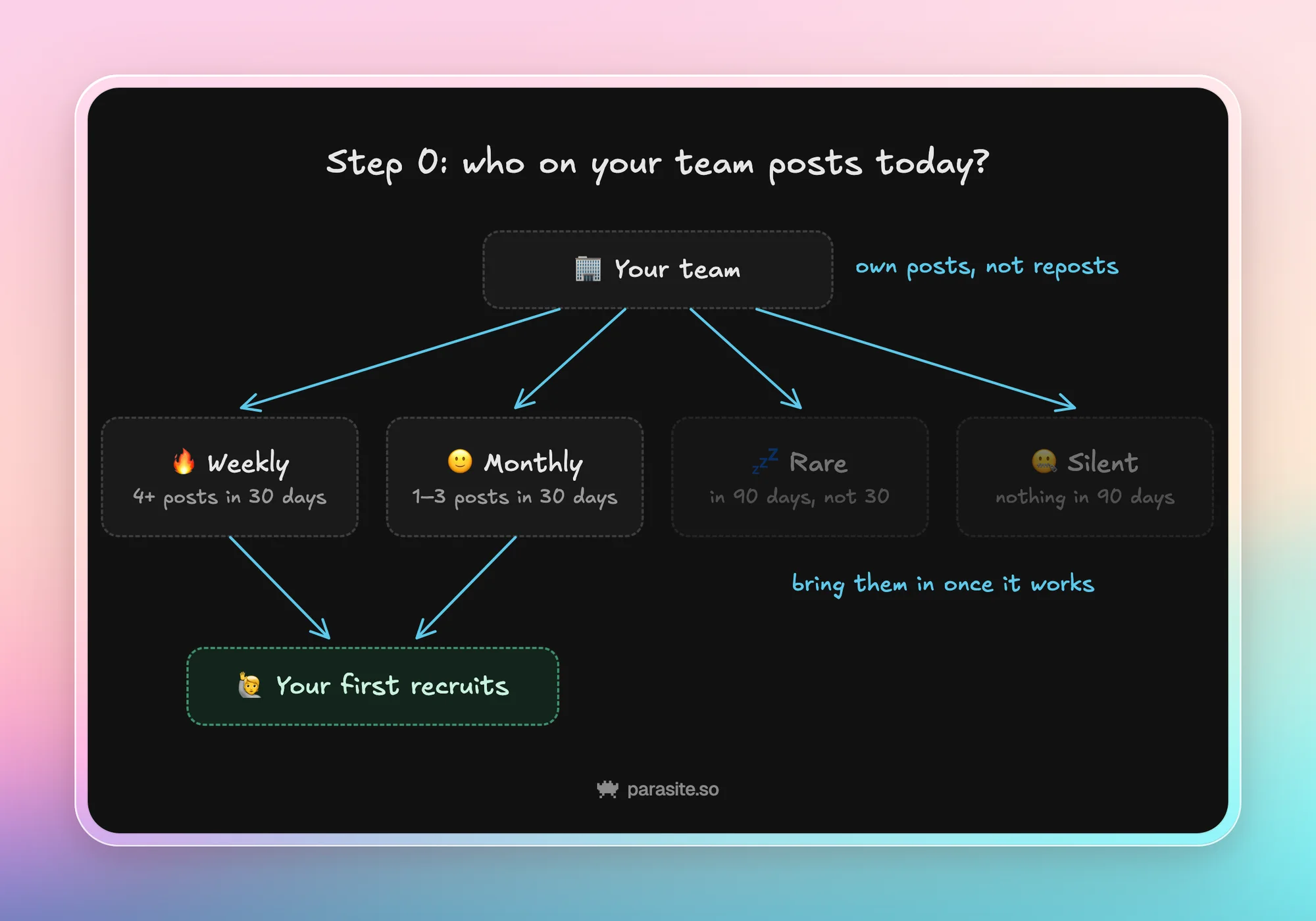
Start with the people who already post. Bring the rest in once you have results to show them.
A 30-day plan to get your team posting
| Week | What happens |
|---|---|
| Week 1 | Run the audit. Pick 5–10 willing people, founder first. Give each one a topic from their job. Founder posts twice. |
| Week 2 | First 20-minute weekly session: everyone brings one thing that happened at work. Everyone posts once. Start a shared Slack channel. |
| Week 3 | Everyone posts twice. Teammates comment on each other's posts on the day they go up. |
| Week 4 | First results review: which person and which topic brought in people who match your ICP? Share wins with names. Pass warm engagers to sales. |
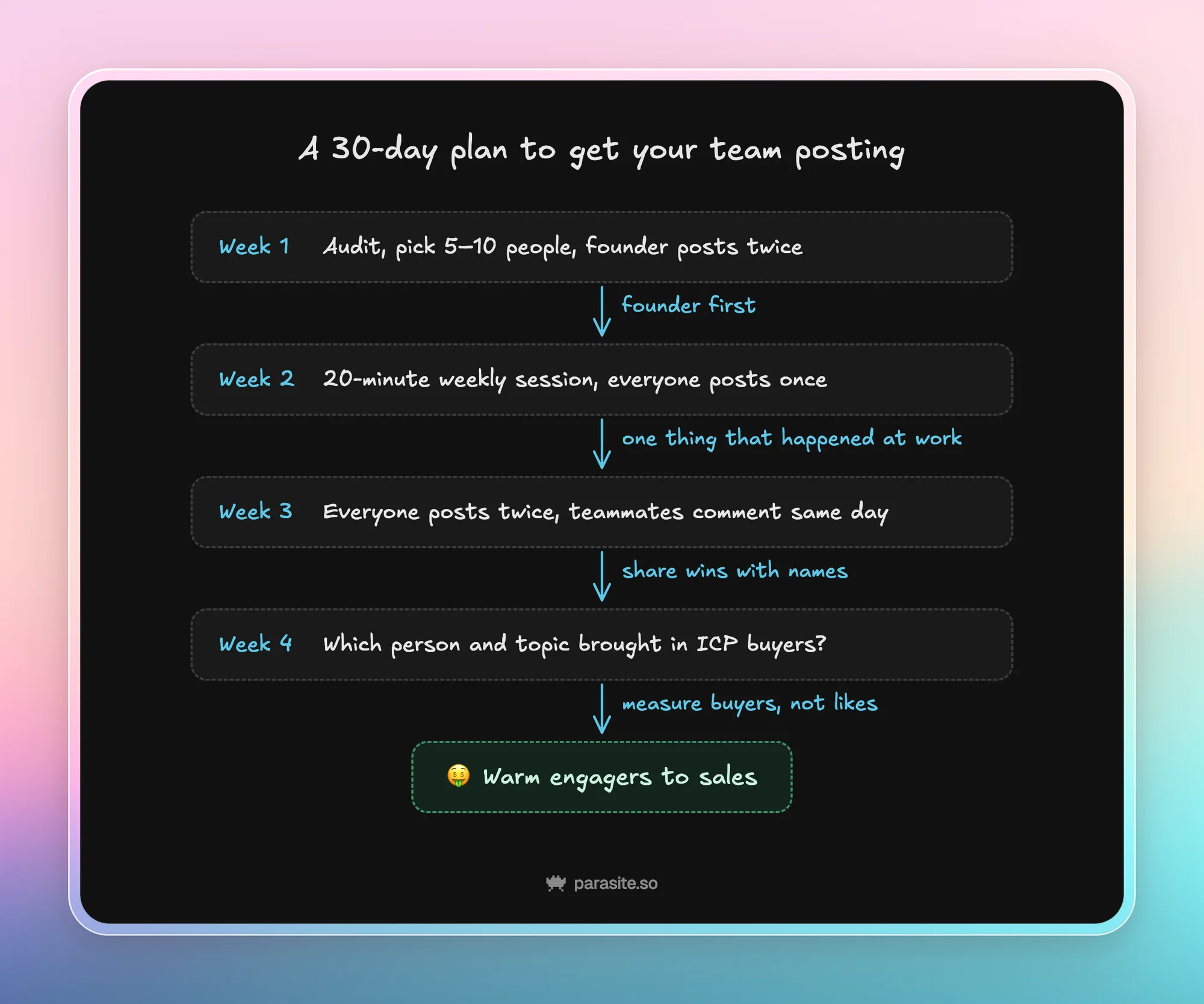
Notice what's not on the plan: a content calendar, brand guidelines, approval flows. You can add those later. Or never.
Measure buyers, not likes
Most team posting programs die in month three. Someone asks "what did we get for this?" and all anyone has is impressions.
Don't let that be you.
Stan counts hires. Pylon asks every demo how they heard about them. Do the same for pipeline: for every teammate's post, count how many of the people who engaged match your ICP.
Two things to watch:
- Coworkers aren't reach. If 6 of your 40 reactions came from your own team, your real audience was 34. Parasite counts each company's own employees separately for this reason.
- Some people pull buyers, others pull peers. Your engineer's build logs might bring more buyers than the founder's opinion posts. You only know if you measure it.
Then pass those people to sales, with the post and comment that brought them in.
That's when posting stops being a brand exercise and starts filling the pipeline.
Frequently asked questions about getting employees to post on LinkedIn
Should we make posting mandatory?
No. None of the four companies here mandated it. Start with the people who already post, make it easy, and share their wins with names. The rest follow once they see it working.
How often should each person post?
Start with once a week, then twice. ColdIQ aims for 3+ posts a week per person, and Pylon's founders post daily, but both built up to that. Consistency matters more than volume in the first month.
What should employees post about?
Their real work. Developers post what they built, support posts what customers asked, founders post what it's like to build the company. Every person needs a topic from their own job, not a script from marketing.
How do you know if team posting is working?
Count the people who engage with each teammate's posts and match your ICP. Impressions and likes tell you nothing about pipeline. Pylon tracks it by asking every demo how they heard about the company.
See who on your team posts today
See who on your team posts today. Run a free company audit: paste your company page and see how often it posts, and how many of your people are weekly, monthly, rare or silent on LinkedIn. No card required.
If you're getting your team posting, I'd love to hear what's working and what isn't. Find me on LinkedIn. I read every message.